Wednesday, December 1, 2010

The Tragedy that is 'Manifest Destiny'

"And about the Indians, considered to be "like animals" by the "settlers" (a very benign euphemism for what they actually were), who did not understand their description as a compliment" (612)

"By viewing the experiences of animals-- such as dogs and "milk cows"- through the lens of human slavery, we come to realize that master/slave relationships permeate our culture" (623).

"cultural blinders hinder our ability to see society's (current) slaves as the individuals they are, while simultaneously obscuring our own motivations from us" (623).


In "Am I Blue?", the narrator explores past injustices to compare to the suffering of Blue, her neighbor's horse. Just as animals were exploited for human incentive, she says, "And about the Indians, considered to be "like animals" by the "settlers" (a very benign euphemism for what they actually were), who did not understand their description as a compliment" (612). Just as the truth about the Native American genocide was hidden behind an iron curtain of American policy, the exploitation behind slaughterhouses and the meat industry is intentionally kept in the dark from American citizens. In order to justify political action, the government constructs policies used to convince the masses for movement. More specifically, the 19th century government created the term, "Manifest Destiny" describing the movement as an inexorable opportunity for the American people to spread democracy across the land. The belief of economic success and overall prosperity was enough for settlers to trust the hands of the government and its expansionary measures. Little did the people know, this movement was responsible for the killing of thousands of Native Americans during this conquest. Native tribes were forced off their land and placed into reservations and "boarding schools", which are interment camps provided by the federal government.


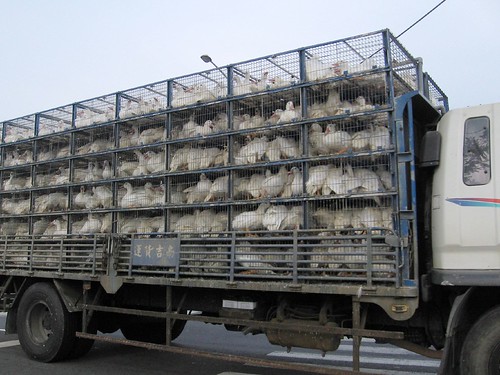
Just as the truth was hidden from the public by political policies during the 19th century, the current voyage in animal testing and medical research has condoned the death of millions of lab animals. This empirical suffering has shown that "By viewing the experiences of animals-- such as dogs and "milk cows"- through the lens of human slavery, we come to realize that master/slave relationships permeate our culture" (623). A lot of our reading discusses the inherent power struggle humans suffer from, but these examples truly illustrate just how devastating the political power dichotomy has become. Just as the Native Americans were seen as means of economic exploit, innocent animals are viewed as sources for anthropocentric development. Our American "cultural blinders hinder our ability to see society's (current) slaves as the individuals they are, while simultaneously obscuring our own motivations from us" (623). Just as we have call for a reparation for our past government's actions, I think it's time to acknowledge the genocide that goes on behind closed lab and research doors. Most of the actions done against these animals are supposedly justified for the sake of medicinal development in the United States. Yet, very little is done to challenge the authorities on this question. This type of ignorance and false hope places the government in the "master" position once again.







Monday, November 29, 2010

Gendering Animal Exploitation

Particularly concerned with women's rights and representations, I found Dunayer's essay compelling as he compares the implications of sexism to Speciesism. Many "Feminists have been acutely aware of connotation, arguing that many terms denoting women come, over time, to take on negative connotations, especially sexual"(Gibbon 25). Dunayer explains that these types of metaphors impose a negative image of both women and nonhuman animals. Similar to Dunayer's views, author Carol J. Adams explains the patriarchal culture's authorization of eating animals. The oppression of women and other animals are overtly interdependent and meat has become a symbol for the patriarchal control of animals. 

Pop singer Lady Gaga justifies her outfit as a criticism against patriarchal
stereotypes claiming she is "not a piece of meat". 

I'll admit, like most people I thought this criticism of patriarchal language was rather trivial. However, every instance of this linguistic practice brings us one step closer to an oppressive state. As long as specisism has existed, patriarchy has similarly been entrenched in society. Early practices of both ideologies enforced human supremacy and patriarchal lifestyles. As men have become more politically dominant, it has become difficult for women to exercise political power over the language and discourse of today's society. The reasoning behind such language suggests that "Patriarchal men would not have linguistically appropriated humanness unless it represented superiority and privilege to their speciesist minds" (591). Apart from language, patriarchy and speciesism have also been applied in the utilitarian framework. Man's excuse for animal dominance is that the exploitation is key for the survival of the greater good of humanity. But "however one interprets it, whatever practical, technical, scientific, juridical, ethical, or political consequence one draws from it, no one can deny this event any more, no one can deny the unprecedented proportions of this subjection of the animal" (599). At an early period of human civilization, meat has been a valuable economic commodity; those who controlled this commodity achieved power. Affluent families hunted and dined with massive amounts of meat, whereas poorer or lesser off communities would rely on vegetables for sustenance. Our conquest of meat and "This reduction of the animals, which has a theoretical as well as economic history is part of the same process as that by which men have been reduced to isolated productive and consuming units" (606). Feminist could argue that to remove meat is to threaten the structure of the larger patriarchal culture.


Gibbon 1999 (Margaret, Professor at the School of Applied Language and Intercultural Studies, Dublin City University, “Feminist Perspectives on Language, Pg. 25-26)


Monday, November 22, 2010

We need factories of death; we need factory animals.


            Although Elizabeth Costello is portrayed as a feeble aged woman, she remains strong and passionate by defending animals rights and her philosophy. Similar to Costello, Kafta stands before an academic audience speaking on behalf of his passion. Kafta says, “For the Academy it will not provide anything essentially new and will fall far short of what people have asked of me and what with the best will I cannot speak about- but nonetheless it should demonstrate the line by which someone who was an ape was forced into the world of men and which he continued there” (558). Both Kafta and Costello might feel otherized from the Academy but nevertheless they express their unique beliefs. Costello is aware of the dissent surrounding her beliefs yet it does not seem to influence her. In fact, Costello’s own daughter in-law disagrees saying “I find her philosophizing rather difficult to take” (91). She continues to say, “Respect for everyone’s world view, the cow’s world view, the squirrel’s world view, and so forth. In the end it leads to total intellectual paralysis” (92).


            Along with many other people, Norma questions Costello’s speeches, which attempt to move towards biocentrism. During Costello’s lecture, she alludes to Ted Hughes’ poem called ‘The Jaguar”. Costello explains that the poem brings record of an interaction or engagement with the jaguar saying, “His stride is wildernesses of freedom: The world rolls under the long thrust of his heel” (568).  Furthermore she suggests that this personification diverts from the connection from animals and humans, and looks only in the abstract. Costello continues to explain that this artificial connection assumes animals act through the individual. However, man is the only species that can act and think so individualistically- for the sake of our ecosystem. She also criticizes society for the exploitation and commodification of animals. Costello explains that in order to satisfy our desires “we need factories of death; we need factory animals” (97).  This type of dehumanization is also analogous to the Holocaust. Jewish philosopher Adorno defends such comparison saying, “Auschwitz begins wherever someone looks at a slaughterhouse and thinks: they’re only animals” (570).  

Wednesday, November 17, 2010

The Philosophers and the Animals


"We can only have one death of our own; we can comprehend the deaths of others only one at a time.  In the abstract, we may be able to count to a million, but we cannot count to a million deaths" (63). 


"It is a philosophical language in which we can discuss and debate what kind of souls animals have, whether they reason or on the contrary as biological automatons, whether they have rights in respect of us or whether we merely have duties in respect of them" (66).


"At the beginning of "The Poets and the Animals" we are offered the quet anger of a poet who objects to Elizabeth Costello's analogy between the murdered Jews of Europe and slaughtered cattle" (509). 


Elizabeth Costello, an aging somber women, speaks on behalf of the silenced animals who have been slaughtered and killed for human's desire. Although she is depicted as frail and weak, Coetzee emphasizes her power and fervor when lecturing at the university. In fact, Costello is so ardent about her position that "At the beginning of "The Poets and the Animals" we are offered the quet anger of a poet who objects to Elizabeth Costello's analogy between the murdered Jews of Europe and slaughtered cattle" (509). To entice the audience, Costello compares the killing of animals to a genocides saying, We can only have one death of our own; we can comprehend the deaths of others only one at a time.  In the abstract, we may be able to count to a million, but we cannot count to a million deaths" (63). With this said, many argued Costello undercut or devalued the Holocaust. However, if anything, Costello reveals that this ongoing violence is present even today. Many animal liberationist made this comparision in terms of the violence, destruction and dehumanization both have caused. Similar to the Agricultural industry's practices, Nazi German inflicted similar pain on innocent citizens. During this period, "Some Jews' skins were preserved by Nazis for example, to be used for lampshades. Obviously, animals are themselves skinned for furs, feathers, and leather" (538). 


Just as the conquest over animals is defined as Speciesism, Nazism was solely fueled on biological racism and anti-semitism. Those who oppose this comparison argue it's moral intentions against victims of the Holocaust. But I think Costello's speech and her analogy was justified to shed light on such an alarming issue. Rather than taking offense to such a claim, we must acknowledge the magnitude of animal abuse in today's society. Rather exhibiting denial, Costello's comparison forces us to remember and acknowledge our injustices. 


Tuesday, November 16, 2010

Earthlings Part II

"The time has come for each of us to reconsider our eating habits,
our traditions, our lifestyles and fashions, and above all,
our way of thinking."

While watching the second portion of this film, my main concern was looking for a solution to the problem. After seeing each heart aching scene, I desperately hoped for some sort of solution or alternative to the status quo's dehumanization. Although Earthlings does not necessarily provide a step-by-step process for animal abuse, it sought a more ideological shift away from instances of Specism. The film urges that "The time has come for each of us to reconsider our eating habits, our traditions, our lifestyles and fashions, and above all, our way of thinking." Rather than taking a radical stance, I think the film proposes a gradual shift away from what our accepted norm. Because the consumption and commodification of animals has been so deeply rooted in society's culture, rethinking of our ways seems most appropriate. 
We must question our ethics when it comes to
the commodification of animals.
In addition to this rejection, another plausible solution is through questioning the state in matters of animals rights and protection. Organizations such as the Animal Liberation Movement seeks legal action towards the emancipation of fellow earthlings. The ALM seeks an end to the moral and legal distinction drawn between man and animal, an end to the exploitation, and an end to their use in the research, food, clothing, and entertainment industries. Legally speaking, Liberationists criticize The U.S Department of Agriculture for enforcing stricter laws in the status of animals as property. 
Personally, I find that taking a firm stance against animal abuse is the only way to ignite change. So in addition to instigating an ideological shift, we must challenge the authorities who allow such atrocities. 


Monday, November 15, 2010

Psychoanalysis of Sadism

Sadism and the human psychology is heavily
linked to animal abuse.
For years, psychologist have searched for the underlying motives for those who abuse animals. Concerns have risen that "In addition to growing sensitivity to the rights of animals, another significant reason for the increased attention to animal cruelty is a mounting body of evidence about the link between acts and serious crimes of more narrowly human concern child abuse, rape, and homicide" (497). Research has shown that these acts are conducive to sadist behavior. Sadism, is the "Enthusiasm for inflicting pain, suffering or humiliation on others; spec. a psychological disorder characterized by sexual fantasies, urges, or behavior involving the subject of another person to pain, humiliation, bondage, etc." (485). There is growing empirical evidence for the connection between animal abuse and sadist violence. In Hogarth's The Four Stages of Cruelty boy's who are portrayed innocent are, "Conspicuous in the center of the plate, he is shown being assisted by other boys to insert an arrow into a dog's rectum"(492). As grotesque as these scenes are, they reveal the disturbing tendencies of the human psychology. Those who study psychopathy conclude that sadism is strongly suggestive that the sadist carries the desire to control and dominate their objects. During the process, the emotional detachment from people or animals allows them to dehumanize the subjects.  This form of aggressive behavior has taken a sharp affect on animals in all industries and aspects. Unfortunately, man's attempt for dominance has resulted in thousands of animals to be tortured, killed, and slaughtered. Not only do I empathize for the innocent lives lost but also for the those who experience such disturbing feelings.
The story of Tom Nero reveals the
motives behind sadist and animal torturers.


Earthlings Part I


"Though among the members of the human family we recognize the moral imperative of respect (every human is a somebody,not a something), morally disrespectful treatment occurs when those who stand at the power end of a power relationship treat the less powerful as if they were mere objects."

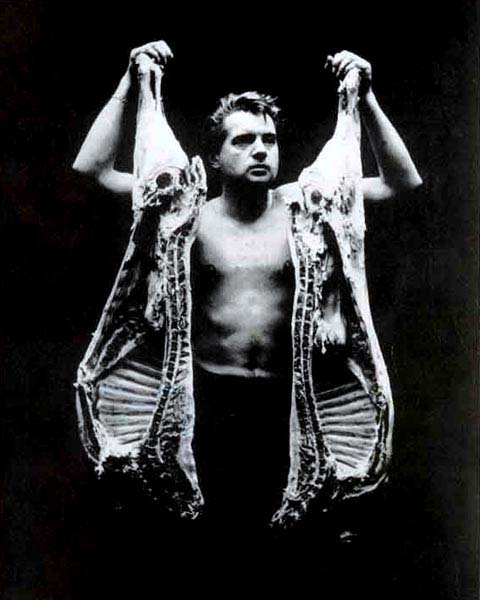
Francis Bacon's "Painting" depicts beef carcasses hanging as an
allusion to the massive killings during the holocaust
As disturbing and grotesque the film Earthlings was, I think it was imperative that we unveil the truth as to what atrocities humans commit against other species. The most compelling aspect of this documentary was the relation to humans and their desire for power and conquer over the weak. The film explains that, "though among the members of the human family we recognize the moral imperative of respect (every human is somebody, not a something) morally disrespectful treatment occurs when those who stand at the power end of a power relationship the less powerful as if they were mere objects". The film suggests that the ongoing slaughter of animals could be compared to the Holocaust in 1933. We often considering preying on the weak as a barbaric action, but Earthlings reveals how this marginalized hierarchy is present in every aspect of our lives. Science, recreation, and agriculture are just a few fields where we have exploited animals for anthropocentric gain. There comes a point in time where we must draw a  line for what is ethical and what is not. If holocaust was deemed one of the greatest acts of inhumanity on this world, what makes this any different? Similar to animal testing, the Nazis would conduct brutal experiments on innocent Jews under the justification for science. Dr. Josef Mengele, known as the doctor of death, was highly known for his brutal experiments, specifically on children. Being brought up in this society, we have learned that these past actions were both extremely unethical and barbaric to the human race. Yet, the slaughter of thousands of animals is never contested. This supports the idea that we as humans desire the ability to exercise our power in sometimes inhumane ways. As the quote explains, it is easy for us to commit to our moral imperatives when it is in respect to our equals. But in some instances, we try to create a marginal distinction through imposing power, authority, and coercion. 
German Nazis were responsible for some of the greatest inhumane
acts committed to a group of people. How are they different from
animal abusers?