Tuesday, April 5, 2011

BB Museum

While visiting the Bob Bullock Museum, we were told to keep ideas of diversity in mind. Each level of the museum depicts a period of history relevant to the development and growth of Texas. Although Bump asked us to note the diversity in Texas history, we can see that there were also earlier instances of assimilation, racism, and white imperialism.
            The first floor explores the original Native Americans who inhabited the Texas land. Spanish conquers infiltrated the land and imposed Western religion, practices, and laws on the indigenous people. It was difficult to find an instance of diversity on this level, because frankly, the Spaniards condemned any sense of diversity. Prior to their exploration, there were many tribal groups who cohabited the Texan plains.  Although their coexistence was not necessarily harmonious, they managed to sustain life amongst the diverse Texas landscape.
Westerners established churches and missions in attempt to "civilize" the Native Americans.

            The second floor is dedicated to Texas as a republic and its development both economically and socially. The museum calls this floor “Building the Lonestar Identity”. Texas became an independent nation in 1836 as a result of the Texas Revolution. Once again, it is difficult to see diversity flourishing at this time. Although many immigrants traveled to Texas, most of them were given unequal opportunities. In fact, white men were the only people allowed to vote. African Americans, Native Americans, Tejanos, and all women were forced to abide by legislation imposed by white men.  Many of these non-white citizens had little opportunities economically. Men were mostly sharecroppers to white landowners and received little compensation for their labor.
            The third floor, called: “Creating Opportunity” explores modern Texas and its growth as a state of diverse populations. Although our history displays little opportunity for minorities, the past 50 years have yielded opportunities to all groups of society. This floor explained that new sectors like the oil industry brought success to Texas cities. As a result of this urbanization, many people sought social equality. In fact, members of NAACP in the 1940s began establishing rights for African American men and women in Texas cities like Dallas and San Antonio. A new culture arose of ‘Tex-Mex’, which mixed American heritage with Hispanic culture. Even the music industry brought upon diversity in society. T-Bone Walker became a famous Dallas-native who brought blues music to Texas. Walker incorporated Texan culture with his style as an African American artist.
T-Bone Walker: an example of the diverse culture in Texas

            As we can see, the modernization of Texas has sparked diversity and new appreciation of hybrid cultures. Although historically, Texas was not one to celebrate such diverse cultures, its development as a state has brought upon positive change. 

A mosaic of all cultures in Texas


Video: T-Bone Walker incorporates Dallas blues with his own style as an African American. An example of diversity in Texas.

Monday, April 4, 2011

4/5 Gender, Diversity, and Family Dynamics

I found these autobiographies interesting and very relatable, partly because all of the students were our age, and were experiencing encounters similar to ours. The three students, both raised American, have other racial backgrounds. Miguel, the first students, explains: “I never found a place where I fit in, where my identity wasn’t qualified by my race—and later by my sexual orientation (838). I feel like this is often true, not just from children but adults too. As Bluest Eye explains, appearance often contributes to power and class. These students struggle to defy the racial and gender stereotypes of their time. At a young age, children are influenced by their parents’ views on others. Even though Andrade struggles to find her “identity” apart from her race, she is still exposed to this type of discrimination in her very own family. She explains, “There were about thirty of them, though whom my mother found jobs cleaning “gringos” apartments in New York City” (847). This implies that her mother probably referred to her clients as gringos (racially derogative term for a North American or Anglo-Saxon). How can she escape racial profiling in her community and school if her own family adopts the same practices? Andrade explains later that her mother “She blames my non-belief partly on my education, partly on my free will as an American-raised woman, and partly simple on me” (851).  Once Andrade grows older, she begins to identify herself sexually in a way that upsets her mother. As Andrade attempts to find solidarity in society, she simultaneously struggles to seek her mother’s “approval”.
A fine example of racial ignorance
            Eliminating racism and prejudice today is a difficult and challenging quest for most young adults. In fact, Bluest Eye explains that racism is a complex, multi-faceted structure that is ever-present in our lives. In order to re-conceptualize what it means to identify oneself, we must embrace our differences. Miguel explains that when “white students,” ask him about his background, he is hesitant to respond. Why?? I am proud of who I am, and what my background is. Although I was born in New Jersey, I still identify myself as an Indian. I think it is ignorant to deny the fact that race is a contributing factor in our identities. I’d like to think that part of my personality stems from the fact that I was raised with Indian parents—and I take pride in that. Andrade’s brother returns from college and she explains, “Something apparently led him to look inside himself and dig out his raices—his roots” (845). Just like her brother, we must embrace our culture, our roots, and our history. The final student also explains, “Through those voices, I saw other piece of my “Self”, another piece of what it means to be a Latino” (858). These two men see that being Latino is part of who they are. –Something you cannot escape.
Texas' celebration of Holi is an example of embracing cultural diversity.
By accepting these traditions and practices, students take pride in their culture.

            So when the question arises, how do we embrace diversity, I believe diversity begins when we appreciate who we are--   whether that is identified by a race, gender, sexuality, interest, love, or anything. There are many things that make us who we are, and race is an inevitable factor in this equation. So embrace it. 

Wednesday, March 30, 2011

Bluest Eye II

Racist depictions of African Americans in everyday-life


From the horrific rape scene to Pecola’s feeling of abandonment, Morrison explores the dark reality of racism and idealized beauty. At the beginning of the book, we see that Pecola dreams for blue eyes—a symbol of acceptance from the world. We see that not only did beauty mean love, but also establishes a strict racial hierarchy.
The "science" of racial hierarchy 
 Young girls take notice that even in the classroom, racism determines who has “power”. Their classmate, Maureen, is a half-white student who receives attention from teachers and other boys in her class. This idea of power is seen in almost every aspect of Pecola Pauline and Frieda’s lives. The narrator says, “Along with the idea of romantic love, she was introduced to another- physical beauty. Probably the most destructive idea of human thought (123).  The girls' idea of beauty is obscured because of the world they are exposed to. In fact, "She regarded love as possessive mating, and romance as the goal of the spirit" (122). Now this is partially true, without love, we are alone. But the problem is, the girls associate love with physical beauty--more specifically, white beauty.
The novel explains that beauty is far more impactful than meets the eye. In order to examine its implications, we view the story through sympathetic imagination. The narration gives us a first hand view at racism in the household and how it affects even the most innocent beings-children. Bump explains, “What is the thing? I would suggest that ultimately it is judging by appearance, and that Morrison focuses on ugliness to enable white readers to feel something of what it is like to be judged by racial hierarchies of skin color and the master and family narratives that reinforce them” (368).  Obviously, none of us can fathom can feeling of rape or the abandonment like Pecola. But, Morrison shows just what pain racism can bring upon society.  Going back to the beginning of the book, an excerpt talks about a house, modeled by the Dick and Jane stories. This story reminds us what people associated “whiteness” with during the post Great Depression era. “Blackness”, however, was associated with “Abandonment may be the central emotion even in what readers simply accept as the happy “white middle class myth” of the family introduced in first words of The Bluest Eye. (391). This racial hierarchy was a powerful tool determining who had the right to power. Eugenics, the study of racial distinction based on the body, was a popular concept for many years. In fact, the University of Texas had its own department on Eugenics studies. Although eugenics quite appalling today, many academics and scientists believed that this study required legitimate research. 
Many universities had eugenics departments dedicated to racist research.

            Written in the 1960s, Bluest Eye coincided with the “Black is Beautiful” movement. During times of social reconstruction, Morrison depicts the early origins of the beauty/race dichotomy. Pecola dreams for blue eyes until finally, she reaches a point of insanity. Pecola truly believes she possess blue eyes, in other words, ultimate beauty. She explains, “If there is somebody with bluer eyes than mine, then maybe there is somebody with bluest eyes. The bluest eyes in the world” (203). Pecola, the epitome of innocence, yearns for the eyes of a white girl. This horror of her yearning is “exceeded only by the evil of fulfillment” (204).
Black is beautiful: Eliminating standards of beauty

Monday, March 28, 2011

P3_FINAL


An Animal’s Eyes: Windows to the Soul
A refuge for animals in Austin, the Austin Pets Alive! facilities offer temporary shelters for abandoned cats and dogs. As you enter the cattery, the façade of the building appears joyous and cheerful. Bright green walls and pictures of owners create feelings comfort and safety to neglected animals.  In fact, the cattery resembled a child nursery more than a shelter for animals. It’s almost enough to make you forget the stories of these abandoned animals. And although each animal may have a different story, they all have faced the rejection no animal or human, should have to endure. When you look into the eyes of these animals, it’s as if they are communicating their past suffering to you. We see sorrow, despair, but also hope. Despite these troubling experiences, these animals remain optimistic for a new home. Understanding Hippie’s background offered insight into the ethical treatment these creatures have endured. A unique encounter with a shelter cat, interacting with Hippie showed just how valuable each and every life is.  Although his story is not fully known, we can assume that it might have gone something like this.

Caged, but not for long.[1]

Hi, y’all! My name is Hippie and I am a black cat native to Austin, Texas. For a portion of my life, I wandered the streets until I finally was taken to the APA shelter. I was born to a family in November. My mother was raised by Austin residents Kate, Jon, and their three young children. Because my mother was never spayed, she surprised the family with a litter of kittens. When my owners first brought my mother home from the pet store, they made the decision not to spay her.  From what I know, my father was a stray cat who was also not neutered. Unfortunately, many pet owners feel that neutering an animal emasculates the owner. If anything, I think these measures are important to ensure a safer lifestyle for pets. At first, my family took care of all of us. The children were excited to raise adorable kittens on their own! The first few months were a time full of love and pampering for my brothers and sisters. But over time, I began to notice this joyful facade was only masking a darker truth. Sometimes the father of the house would grow angry and often violent. During these outbursts, I tried my best to hide in the kitchen cabinet or underneath the couch. When I first met this family, everyone seemed so loving. But the harsh reality was that the father’s violent impulses slowly destroyed the family. When the male owner was especially angry, he would hit his wife or yell loudly at her. I would hear glass shattering and shrieks from the distant room. On these nights, he would lock us in our crates for hours without food or water. I heard the children crying in their room.
Shattered glass remains after one of the family’s fights. [2]
The children saw us starved and behind cages. I could see in their eyes that both the abuse of their companion animals and the violence of their father was psychologically destroying them. This continued for months until one day, an unfamiliar woman came to the house. I couldn’t understand much, but she did say that she was a social worker. As I watched, she took the children away in a car. We waited for a while until another man came into the house. This time, he took me and the other cats and drove off. As we peeked through the cage and looked out the rear window, we could see we were driving farther away from our house.
Some humans think that they are a superior race. They may think that they are masters of development, technologic breakthroughs and so on. But there is one thing we animals have that most people don’t seem to understand, unconditional love towards all beings.  Many people think that pets are disposable items like toys, which they can rid of at their convenience- but we have feelings too. In fact, cats experience separation anxiety when apart from their family or favorite person. Never had I felt so alone. I didn’t get to say good-bye to my mother or my other brothers and sisters. My owners felt that spaying my mother was inhumane, but they failed to recognize the inhumanity of abandoning animals.
After some time, an older woman who drove by stopped and carried us back to our car. My little body shivered with fright as we rode in the stranger’s car. But she seemed quite friendly. At least this stranger, unlike our owners, took us in her care. Several minutes had passed until we could see city buildings out the window. The car finally made a stop near a gray building. From the parking lot, I could hear other animals from the buildings. Loud barking mixed with faint voices perked my tiny ears straight up. “You are going to stay here for awhile”, the woman said to me. As we entered the building, I peeked my head out of the box. The room was bright green with flowers painted on the walls. I could see joyous faces and several other cats in the shelter. Several young women who smelled of sweet perfume greeted me with honey-sweet voices.  For the first time in a while, I remembered what a smile looked like. Their soothing voices brought immediate comfort. Am I home?  Wire cages were lined along the walls housing other cats and kittens. I know the shelter is a loving place, but it is not a home. A home is a place where I always have someone there who loves me. A home is a place where I never have to be afraid. Finally, a home offers undying love.
Not quite “home”, but still an improvement.[3]
They say that cats have nine lives, but we only have one heart. I know that my past will always be a part of me, but it’s not who I am. Many people think that shelter animals are more burdensome than new pets, but we all are the same.  We all deserve to love and to be loved by the right human companion or family!
Visiting the animal shelter was an eye-opening experience, nonetheless. Animals have, and always will play an important role in the human world. Whether as a source of food, labor, sustenance, or companionship, animals contribute to our very survival. However, for the sake of our wellbeing, the conditions and suffering of animals is often marginalized in our eyes. This relationship we’ve maintained is far from balanced, but rather is a hierarchal structure where anthropocentricism continues to dominate society in multiple ways. While many ancient cultures idealize, even worship animals, contemporary society disregards the animals as mere commodities. Although the animal shelter is just one instance of animal abandonment, my experience with Austin Pets
Alive! and my relationship with the cat Hippie sparked concern for the ethical treatment of animals.
From the earliest account of human civilizations, animals and humans have shared a close relationship. It was the first concepts of ‘domestication’ that brought the idea that animals were property not autonomous beings.[4] In fact, it was Karl Marx and Friedrich Engels who explained that labor and production was the primary criterion that set mankind apart from other animals.[5] As a result, we often disregard the welfare of other creatures. Although cats and dogs are not necessarily bred for production purposes, their ultimate “purpose” is to serve as our companions. This is their “labor”, this why we “produce”, in other words, breed cats and dogs. Across America, animal shelters have become temporary refuge for the surplus of domesticated animals. It may seem disheartening to refer to the shelter population as a ‘surplus’, but it is the unfortunate truth. We have justified the exploitation of animals by abandoning animals at our convenience. I was relieved to know that Austin’s animal shelters practice a “no-kill” policy. These animals are spared their life but they still experience the feeling of neglect everyday.
Walking into the Manchaca cattery, I could see walls painted with bright green, flower décor everywhere and smiling faces greeting me. Despite its encouraging appeal, I could not help feeling despair. This is the home of hundreds of abandoned animals. Innocent and eager, this is where they remain hopeful for love and security. As I entered, two friendly women, one who escorted me to Hippie, greeted me. “He’s very gentle”, she
says. I thought to myself, “I must’ve lucked out” (I was never good with cats). I remembered Bump once saying, “The eyes of an animal are the windows to their soul”. So, I willingly gazed deep into Hippies eyes. What was he telling me? Almost instinctually, he pierced his verdant eyes right back at me. As if with deep concentration, my new feline friend peered into my eyes with wonder and intrigue. It took me days afterwards to understand exactly what that encounter meant. Maybe he was trying to communicate with me, or maybe, it meant nothing.  But instantly, I grew an attachment to Hippie. He is gentle, quiet, and watchful. As I stood there taking pictures of the enigmatic creature, he stood patiently for every flash of quick light. His lush, velvet black fur and soft purring sounds encapsulated just what a majestic animal he was. As people we often attach humanistic qualities to animals. I used to think this was foolish and naive of us. I would ask myself, how do we know what they’re feeling? Who are we to decide that the animals want? But this brief encounter refuted this previous assumption. It’s not that we humanize animals, but we personify them. We see this anthropomorphic behavior in Alice in Wonderland and Ishmael, where humans share strong affection for animals by attributing human qualities to an animal. Being exposed to Hinduism at a young age, “Many of the religious texts refer to anthropomorphic figures that adhere to mankind’s perception of the world”.[6] Lord Krishna in the Bhagavad-Gita says man can better conceptualize God when he is in these forms. As I connected with Hippie this way, I understood just how unique our encounters with animals are. From mythological tales to capitalist markets, animals are forever influential in our lives. But now, we must reevaluate our ethics towards these beings. What ethical stance should we take? Do we, and if so, what is our responsibility towards animals?
Cats were always an unfamiliar species to me, and yet, I quickly grew a strong connection to my furry counterpart. Just like me, he yearned for freedom in life. I could see Hippie’s unrest. Though he was calm and tranquil, I could see something was missing--love.  He was made to experience this world, and not to be confined in a metal cage.
Hippie: Out of the cage and ready to explore this world. [7]

Bio Description: 
Peaceful - Adaptable - Lap Cat
There couldn't be a more purr-fect name from this adorable adult cat. Hippie is a very peaceful and loving cat. He has soft velvet-black fur with a small patch of white on his chest. He also has beautiful big green eyes that will take your breath away. Hippie is very approachable cat, even to most strangers. He will sit on anyone's lap and purr softly. He is very friendly to anyone, including kids. He enjoys being scratched on his belly and behind the ears. He loves exploring new places and meeting new faces. Hippie is very adjustable and friendly with other animals. He loves lounging around or playing with his toys-he rarely causes any trouble. Hippie is an excellent addition to any welcoming family. As long as you show love and affection to Hippie, the feelings will surely be returned! He is more than ready to find a new home! Come visit Hippie and see just how sweet he really is! 


FINAL COUNT: 1963
W/O QUOTES: 1948

[1] Taken by Sonali Kalvala
[2] Image: https://www.ownerbuilderbook.com/images/journal/full/8786.jpg
[3] Taken by Sonali Kalvala.
[4] Serpell, James. In the Company of Animals: A study of human-animal relationships. London: Cambridge University Press, 1996.
[5] Manning, Aubrey, and James Serpell. Animals and Human Society: Changing Perspectives. London and New York: Routledge, 1994.
[6] Barrett, Justin, and Frank Keil. "Conceptualizing a Non-natural Entity: Anthropomorphism in God Concepts." Cognitive Psychology 31, no. 17 (1996): 219. http://www.wjh.harvard.edu/~lds/readinggroup/barrett1996.pdf (accessed March 28, 2011).
[7] Taken by Mantis.

Wednesday, March 23, 2011

Bluest Eye I

"Survival of the Prettiest"
One of the biggest themes of this book seems to be sexuality and the exploration of beauty and what it means to be a woman. Pecola, for instance, struggles with becoming a woman and understanding what love is. She says, “my man, who before leaving me, would love me” (32). During those socioeconomic times, these women remained inferior to their men. Their youth and innocent is conflicted with thoughts of love and sexuality. In addition to their experiences and encounters with men, the girls are heavily influenced by white society and their standards of beauty.
Society predetirmines the standards of beauty and pressures women
to conform. 
“Bluest Eye” refers to the desire for perfection that these girls seek. The protagonist says, “ Adults, older girls, shops, magazines, newspapers, window signs- all the world had agreed that a blue-eyed, yellow haired, pinked-skinned doll was what every child treasured”(20).  Although the eyes not only represent beauty to them, but they are a symbol of love and comfort. As Morrison explains, the family lives in poverty. Claudia describes her house with an “icebox door opening on rusty hinges in July” (21). Society argues that beauty is only a material desire, however, Morrison implies the deeper implication of acceptance. Pecola, Claudia and Frieda are exposed to the harsh reality of living in a rural town just after the Great Depression. Many of their family friends are out of jobs or in jail. In fact, Pecola’s father is sent to prison.  This is contrasted with the white girls who live in town, who are portrayed as living comfortable lives. Maureen, Pecola’s classmate, is described as the epitome of white beauty. She flaunts her beauty as a sign of grace and perfection. Her beauty is related to her parents’ wealth. The girls say, “She was rich, at least by our standards, as rich as the richest of the white girls, swaddled in comfort and care” (62). More than anything, the girls seek beauty as a means of security. The girls hope that with beauty comes love, with love comes a husband and family, and what family comes security. The novel shows how the girls explore these deeper issues as they witness turmoil and despair on a day-to-day basis.
Girls are exposed to pressures of beauty at a young age

This book reflects the conflict many African American women face today in the presence of white society. For example, standards are white beauty idealize long, soft, smooth hair and lean, skinny bodies. Morrison explains , Compared to black males, Black females have been more profoundly affect by the prejudicial fallout surrounding issues of skin color, facial features, and hair” (Ashe). Certainly, Morrison is refuting the argument that beauty is only a material quality. But in fact, it means much more and it is ever-present in the socioeconomic portions of our lives.
"Survival of the Prettiest" does beauty contribute to social status? 

This documentary, "Good Hair" explores standards of beauty, particularly "white" conformity, and its stark influence on modern African American beauty. Just like "Bluest Eye", the documentary argues that women identify beauty as a symbol of social status.


Ashe, Bertram D. "Why don't he like my hair?": constructing African-American Standards of Beauty in Toni Morrison's 'Song of Solomon' and Zora Neale Hurston's 'Their Eyes Were Watching God.'
http://www.questia.com/googleScholar.qst?docId=5000386409

Monday, March 21, 2011

Maus

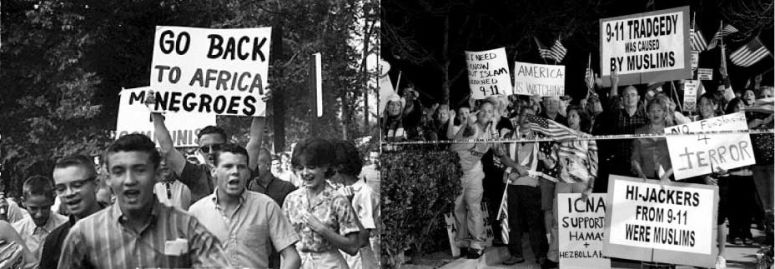
Maus explores the atrocities committed during the Holocaust through the eyes of mice, cats and pigs. Just like the racial disparity of this time, Spiegelman divides the social groups by animal species. The story also addresses the relationship between human ethics and animal abuse in the meat industry. In the documentary Earthlings, the narrator explains, “Though some will argue the suffering of animals cannot possibly compare with that of former Jews or slaves, there is, in fact, a parallel”.  For one, Spiegelman illustrates the social hierarchy during the Holocaust. Mice are representative of the Jews, while cats symbolize the Nazi forces. Pigs are seen as the Polish, who also played an important role in the story. These characters reinforce racial stereotypes through their discrimination towards each other. A Nazi guard screams, “You Jew! You’ve only been here a few days and you’re ready to do business?!” (33).  The injustice during the Holocaust is mirrored in other social equalities today.

Discrimination from the past versus the present
http://www.prosebeforehos.com/wordpress/wp-content/uploads/2011/03/history-america-1951-vs-2011.jpg


The clips during Earthlings show animals herded into production lines awaiting their slaughter. Similarly, innocent men and women were packed in lines forced to perform gruesome tasks. The narrative depicts mice “So the march was going and going, forever we marched and the ones what didn’t fall down, we marched” (83). Both the characters of the book and the victims of the Holocaust genocide were oppressed and treated like slaves.

If anything, this more than obvious similarity shows that humans have repeated this unethical treatment over and over again. We tend to look at thinks like African American slavery and the Holocaust as a thing of the past. Yet, these are two instances of racial discrimination and hatred. Just like we react to the the Holocaust with disgust and remorse, will we look back at these animal slaughters with similar appall? 


Optional DB


As Professor Bump has previously reminded us, “Some of the students in this class are not very Plan II-like”. With that said, I agree with Bat as she says, “I’ve learned a lot this year about my own comfort zones and limitations as a student.” Similarly, our World Lit class has shown my strengths and weaknesses as a ENTJ type and how they affect my learning environment.
Students often put a lot on their plate
Throughout the descriptions for ENTJs, articles explain that we are “natural born leaders”. As glorifying as that felt, it also means ENTJ students can sometimes be stubborn—it’s either their way, or the highway. Especially in this class, we have a predetermined framework of how assignments are graded and how points are awarded. This system is definitely unique in that it is unlike the typical 1-100 point system we are all used to.  This class has taught me patience. It’s not only hard to adapt to a new system, but also excel in the class. Reading Bump’s evaluation of our Typologies, he explains, “ENTJs will approach open-ended tasks with fear, because in their mind, it seems so easy to make a mistake”. Instantly, my first thought was our “Who Are You?” Roadmap. Our first major assignment last semester left me frantic and anxious. Instead of just offering my answer, I wanted to find the right answer. What would give me the best grade? Nonetheless, this approach left me stressed and was inevitably my downfall.
Relaxation helps clear your mind 
But once understanding these shortcomings, I feel like the coursework is more manageable. Meditation is an example of a new learning method I have adopted. Meditating is beneficial because it allows for a brief moment of clarity despite a busy schedule. I often find it hard to focus on just one thing while studying. Taking a few minutes to relax produces a more efficient and less stressful working experience.